
Montgomery County City Directory Holdings
Montgomery County's historical volumes are place-by-place collections. The best documented material is tied to Norristown, Pottstown, and individual communities, not to one countywide publication. The Historical Society of Montgomery County, or HSMC, cites Norristown directory entries from 1880, 1882, 1890, and 1951. The Library of Congress holds digitized Norristown telephone-directory reels. A 1950 Pottstown criss-cross directory is separately identified in the Library of Congress address-directory inventory. Those distinct holdings make the locality printed in a record as important as the surname.
| Montgomery County collection | Known years or run | Custodian | Access route |
|---|---|---|---|
| Norristown city-directory evidence | 1880, 1882, 1890, 1951 cited | HSMC and local historical collections | On-site research or HSMC research service |
| Norristown telephone directories | 1938-1945; 1946-1949; 1950-1952; 1962-1963 | Library of Congress | Digitized page, image, and PDF browsing |
| Pottstown criss-cross directory | 1950 | Library of Congress address-directory inventory | Confirm the holding and access route before relying on it |
| Place and community files | No single date range | HSMC Research Library | Maps, newspapers, cemeteries, schools, and organizations |
| Probate docket books | 1784-1987; computerized from 1988 | Register of Wills and County Archives | Public-access, counter, and archive channels |
The public research does not establish a continuous Norristown run, a publisher for every volume, or a countywide series. Treat those gaps as part of the evidence. A dated local volume can place a listed person, subscriber, or business at a printed address, but it cannot turn an unverified run into a complete chronology.
Montgomery County Norristown Snapshots
Montgomery County's HSMC local-history evidence shows how much a directory can reveal when read as a snapshot. It ties a grocery to 400 West Marshall Street in an 1880 directory and to 419 West Marshall Street in an 1882 directory. Another HSMC article refers to a 1890 groceries category, and a 1951 Norristown volume identifies two frozen-food locations by street. The change between the 1880 and 1882 street entries is a reason to compare both years rather than assume that a familiar name marks one fixed property.
Those examples are evidence of dated addresses, not proof of a household roster. A street change can reflect a move, a different business site, altered numbering, or a printed naming convention. Preserve capitalization, initials, street form, and the directory year in notes. That makes it easier to test the entry later against a deed, probate record, census, or municipal map.
Note: The public research verifies isolated Norristown years, not a continuous directory sequence or a common publisher for all local volumes.
Montgomery County Telephone Directories
The Library of Congress Norristown telephone-directory collection provides four identified reel ranges: December 1938 through December 1945, October 1946 through October 1949, November 1950 through November 1952, and July 1962 through May 1963. Its page, image, and PDF views create a useful online route when the question concerns a mid-century surname or a known address. The collection is telephone-directory microfilm, not a general population register.
White and yellow pages may reveal a subscriber or business name, street address, telephone number, and classified category. A missing entry has several plausible causes: no telephone service, an unlisted number, a business listing, an alternate spelling, or a move between print cutoffs. That limit is important when a Montgomery County directory search produces no match.
Montgomery County Research Drawers
The HSMC Research Collection Index is a shelf guide for the material that can explain a directory clue. It names drawers for maps, roads, bridges, post offices, newspapers, cemeteries, churches, census, migration, schools, military records, societies, and individual boroughs and townships. A Montgomery County directory entry can therefore lead to a place file, church folder, cemetery source, newspaper notice, or historic map without pretending that any one drawer is a searchable person database.
Montgomery County's HSMC library and archives at 1654 DeKalb Street in Norristown offer an on-site route, telephone contact, and paid remote research. Published research-library hours are Monday, Tuesday, and Thursday from 10 a.m. to 5 p.m.; Wednesday from 1 p.m. to 8 p.m.; and the first Saturday from 10 a.m. to 2 p.m. Members use the library without charge, while a nonmember day pass is $7. Remote research is listed at $30 per hour plus copies or scans.
Reading Montgomery County Directory Entries
Read the actual evidence before assigning meaning to an entry. The inspected HSMC examples establish a named person or business and a printed street address for a stated year. The inspected Library of Congress telephone volumes are white and yellow pages, so their strongest fields are subscriber or business name, street address, telephone number, and category. The public sources did not expose an abbreviation key, spouse notation, occupation field, or owner/renter mark for a particular local city-directory page. Do not supply those details for every volume.
| Printed name | Use the spelling, initials, and business form exactly as the volume shows them. |
|---|---|
| Street address | A dated location lead, not by itself proof of ownership or every household member. |
| Telephone number | Available in relevant subscriber listings; useful for distinguishing a business or subscriber. |
| Classified category | A yellow-page category can provide the type of listed business, not a complete personal history. |
| Printed year | The time boundary for the entry; compare nearby editions before drawing a timeline. |
- Criss-cross directory
- An address-ordered volume designed to lead from a street address to a listed name.
- Householder index
- An alphabetical pointer to household listings when a particular volume includes one.
- Print cutoff
- The point when a volume's information was compiled, which may precede the date on its cover.
- Abbreviation key
- A volume-specific legend; use it only when the actual book supplies one.
Note: A volume's own legend controls abbreviations; the inspected sources did not publish one for a particular Montgomery County entry.
Montgomery County Criss-Cross Directory
The Library of Congress criss-cross guide identifies a Pottstown, Pennsylvania, directory for 1950. That is the most directly verified local address-directory holding in the research. It can supply an address-to-listed-name lead that ordinary alphabetical directories may not offer. The guide is an inventory, however, not proof that every Pottstown address appears or that a digitized image is available immediately.
Check the Library of Congress access record before promising a copy. Then compare a listed name with the appropriate property, deed, census, or archival source. A criss-cross result is strongest as one layer in a Montgomery County address history. For current parcel-led work after an older address is identified, the Montgomery County By Street directory follows the county's address and parcel records.
Tracing Montgomery County Directory Years
A household trail needs the year nearest the known event, then a careful comparison on either side of it. Start with the earliest known surname and exact address. Record what the volume prints, including initials, business names, and the locality label. Pair each dated directory entry with a decennial federal census when available, then test a later move through a Recorder deed, probate material, obituary, or historic map. The most recent public federal population census available in 2026 is 1950, so later directory evidence needs another source for confirmation.
- Locate the city or telephone directory closest to the year and preserve the printed spelling, locality, and address.
- Check an earlier and later directory to identify a move, changed listing, disappearance, or persistent address.
- Compare the result with the nearest available census year, keeping in mind that census and directory dates serve different purposes.
- Use a deed, probate docket, obituary, cemetery item, or historic map to test the change suggested by the directory.
- Keep the postal community, municipality, lot description, and street form together when the same Montgomery County address appears under different labels.
A disappearance can mean a move, death, unlisted telephone service, spelling change, or a gap between printing and the event. It does not establish any one explanation. That restraint is especially useful across Montgomery County, where borough, township, and postal-community labels can differ.
Montgomery County Archives Backstops
When a directory lead reaches beyond the available volumes, Montgomery County historical channels offer focused next steps. The Montgomery County genealogy information page points researchers toward historic probate, county birth and death material, and FamilySearch microfilm. Probate docket books run from 1784 through 1987 before the computerized era. County Archives also holds pre-1906 vital material and departmental microfilm, while the State Library of Pennsylvania maintains city directories, local histories, maps, church and cemetery sources, and newspapers.
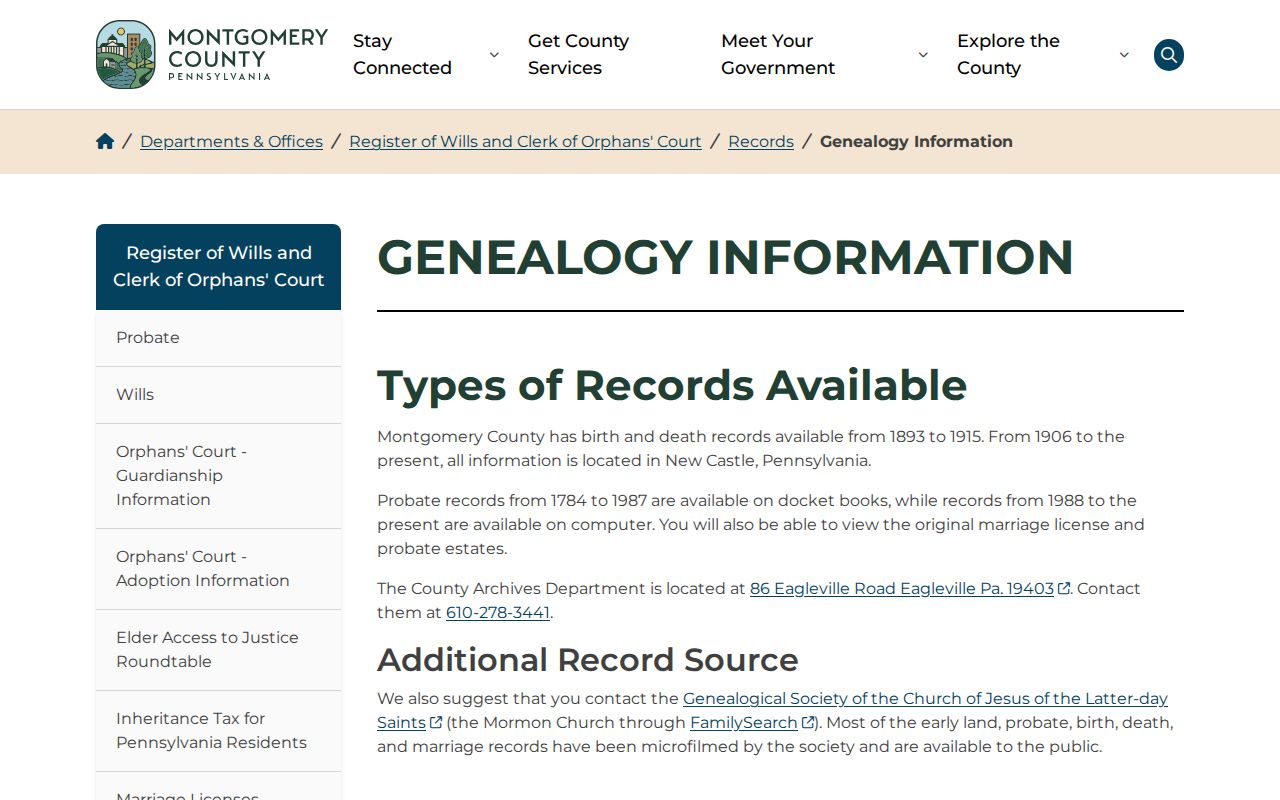
The official genealogy resource is a reminder that a Montgomery County historical volume is one layer among probate, vital, land, and library records. County Archives welcomes walk-ins and retrieval requests, but it does not certify documents. For a certified older civil record, Archives retrieves material and the originating custodian handles certification.
Note: Montgomery County Archives retrieves historic material but does not certify it; obtain certification through the original record custodian.
Montgomery County Directory Gaps
Myth: a missing directory listing proves that a person never lived at the address. It does not. Telephone directories track subscribers, and documented city-directory snapshots do not establish an uninterrupted countywide series. An unlisted number, an alternate surname, a business listing, a move near the cutoff date, or a different municipal or postal label can all change what appears in print.
Montgomery County has 62 municipalities, so there is no single county city hall or unified municipal directory collection to fill every local gap. Identify the borough or township from the county municipal-boundary layer, then use the relevant clerk or local record source for contemporary municipal material. For historical context, HSMC, County Archives, the Library of Congress collection, and probate records remain distinct access channels.
Montgomery County Directory Digitization
A March 2026 Montgomery County agenda described continuing microfilm scanning and uploading within an Archives digitization project. That is a useful reason to recheck the official archive and library channels when a needed year is absent today. It does not establish a countywide online coverage date or mean that every directory is available digitally.
| 1880 and 1882 | HSMC cites Norristown grocery entries at two West Marshall Street addresses. |
|---|---|
| 1890 and 1951 | HSMC references a Norristown groceries category and later frozen-food addresses. |
| 1938-1963 | Library of Congress identified Norristown telephone-directory reel runs across these periods. |
| 1950 | Library of Congress inventory identifies a Pottstown criss-cross directory. |
| March 2026 | A county agenda records continuing Archives microfilm scanning and uploading work. |
Keep the physical and remote options in view. The Library of Congress supplies online telephone reels, HSMC provides on-site and paid research access, and County Archives handles historic retrieval. Those routes preserve the local detail that a broad surname search often misses.