
Montgomery County Resident Lookup Coverage
Use each record for the limited fact it actually preserves. County Property Records can turn a known address into a parcel identity, but its owner-name search was removed in 2022. The Recorder can then connect a party to a recorded land document. Court, probate, voter, and vital-record paths answer different questions and carry different limits. That division is useful when a resident lookup starts with only a name, because it prevents an old deed, a docket entry, or a directory listing from being treated as current residence proof.
| Record layer | What it can confirm | Montgomery County route | Access boundary |
|---|---|---|---|
| Property record | Known address, parcel identity, and property context | Board of Assessment Appeals Property Records | Address or parcel search, not owner-name search |
| Recorded document | Named party, recording date, and land-document trail | Recorder Public Access System | Free account; remote images have a paid access route |
| Court docket | Participant, court activity, dates, and docket status | Pennsylvania UJS Case Search | Public docket sheet, not a certified record |
| Voter record | Self-status or defined statutory list fields | Pennsylvania Find Voter Registration Status | Self-status is not public street browsing |
| Vital or probate record | Documented event, relationship, or estate role | Register of Wills and Clerk of Orphans' Court | Age, eligibility, and custodian rules apply |
Begin with the smallest accurate claim. A known address calls for the assessment application first. A possible court matter calls for a party-and-county search. An heir question belongs with the estate path. Keeping the claim narrow makes it easier to compare two independent identifiers before deciding the records concern the same person.
Montgomery County Court Name Checks
The statewide UJS portal is the public start for a Montgomery County court-name search. Its Participant Name mode uses first name, last name, and county. Other documented modes include docket number, organization, citation number, attorney, calendar event, and other criteria. Basic docket-sheet access is free. A hit supplies a case trail, not a complete file or a general identity record, so use the docket number, court, filing date, and participant role to separate people who share a name.
The official UJS Case Search screen is shown here for the name-and-county portion of a Montgomery County resident lookup.
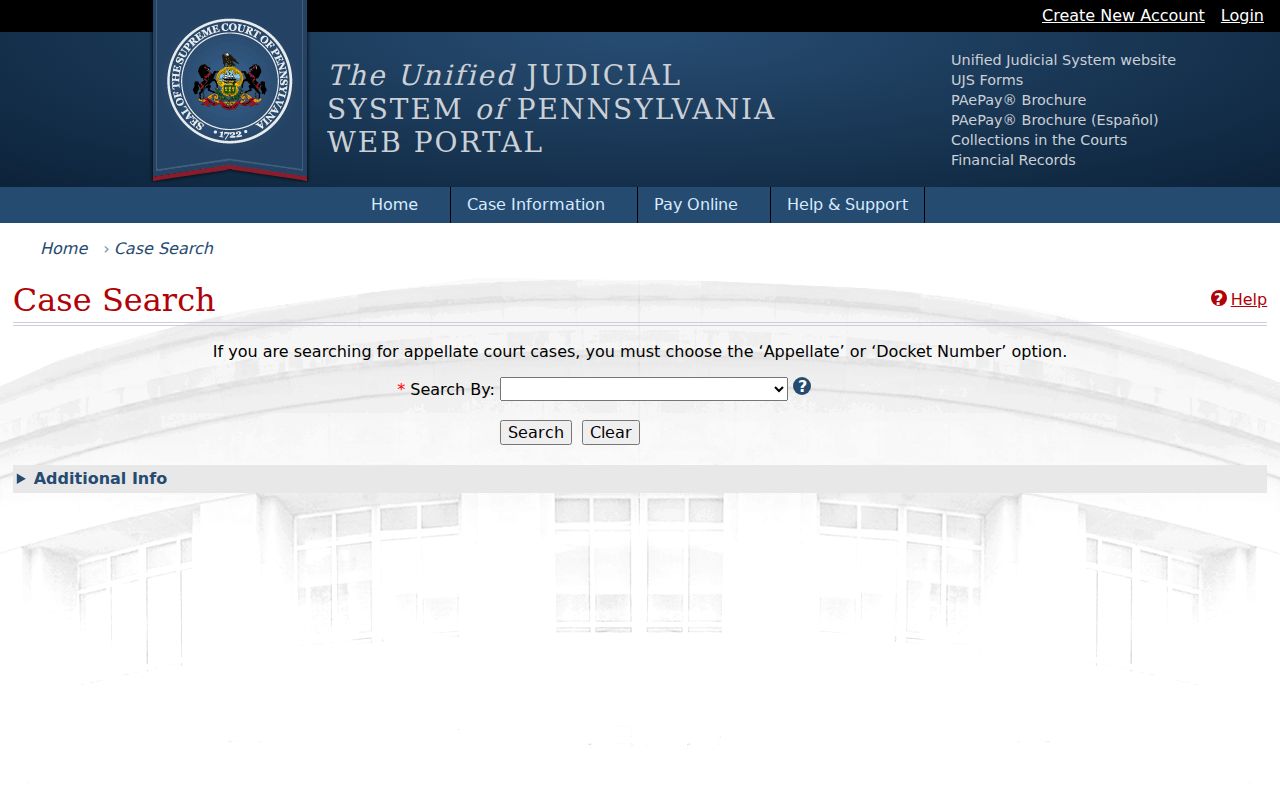
A public docket normally identifies the docket number, court or judicial district, participant names and roles, filing date, case information, docketed events, and case status. Juvenile, sealed, expunged, limited-access, and other confidential matters may not appear. A no-match therefore does not prove that no protected record exists.
A docket-sheet inventory should preserve the fields that distinguish the result from another person with the same name:
- Docket number and court or judicial district
- Participant name and recorded role
- Filing date and case or proceeding information
- Docketed events and hearing entries
- Current case status
| UJS control | How to use it |
|---|---|
| Search By | Choose Participant Name for a name check, or use a docket-specific mode when that number is known. |
| First and Last Name | Try established spelling variants, initials, hyphenated forms, or prior surnames one at a time. |
| County | Select Montgomery to focus the participant-name search. |
| Docket Number | Use the court identifier when a document, clerk, or prior result supplies it. |
Verifying a Montgomery County Resident
Verification means linking a name to more than one stable detail. Montgomery County records often use a postal place name where the tax map uses a borough or township. Save both, along with the address spelling and TAXPIN. The Recorder recommends parcel ID for its FraudSleuth profiles because it is more specific than a common name or address. That same habit helps avoid a same-name match when an address-based property record and a recorded document are being compared.
- Write the full name, known initials, earlier surnames, address, municipality, and time period. Do not merge alternate spellings before checking them.
- When an address is known, search the county property application by address or parcel and preserve the TAXPIN and parcel details.
- Use the address or parcel in the Recorder system. Compare the document party, recording date, legal description, and transfer trail with the property result.
- Choose an independent record that fits the time period, such as a UJS docket, lawful voter-list request, estate file, marriage record, or historical directory.
- Ask the custodian for a copy or certification only when that precise record is needed. A public index and the actual document are not interchangeable.
- Docket
- A court's running record of case activity, filings, hearings, and status. It is not necessarily the original filing image.
- Index and image
- An index points to a record through names, dates, or document numbers. An image is the scanned document or filing itself, which may have separate access rules.
- Certified copy
- A copy issued or certified by the responsible custodian for an official purpose. County Archives can retrieve historic material but does not certify it.
For the full parcel-by-parcel method after an address is confirmed, use the Montgomery County by-street directory. Its address chain is a better fit than repeating a whole-street search during a one-person check.
Montgomery County Civil Record Access
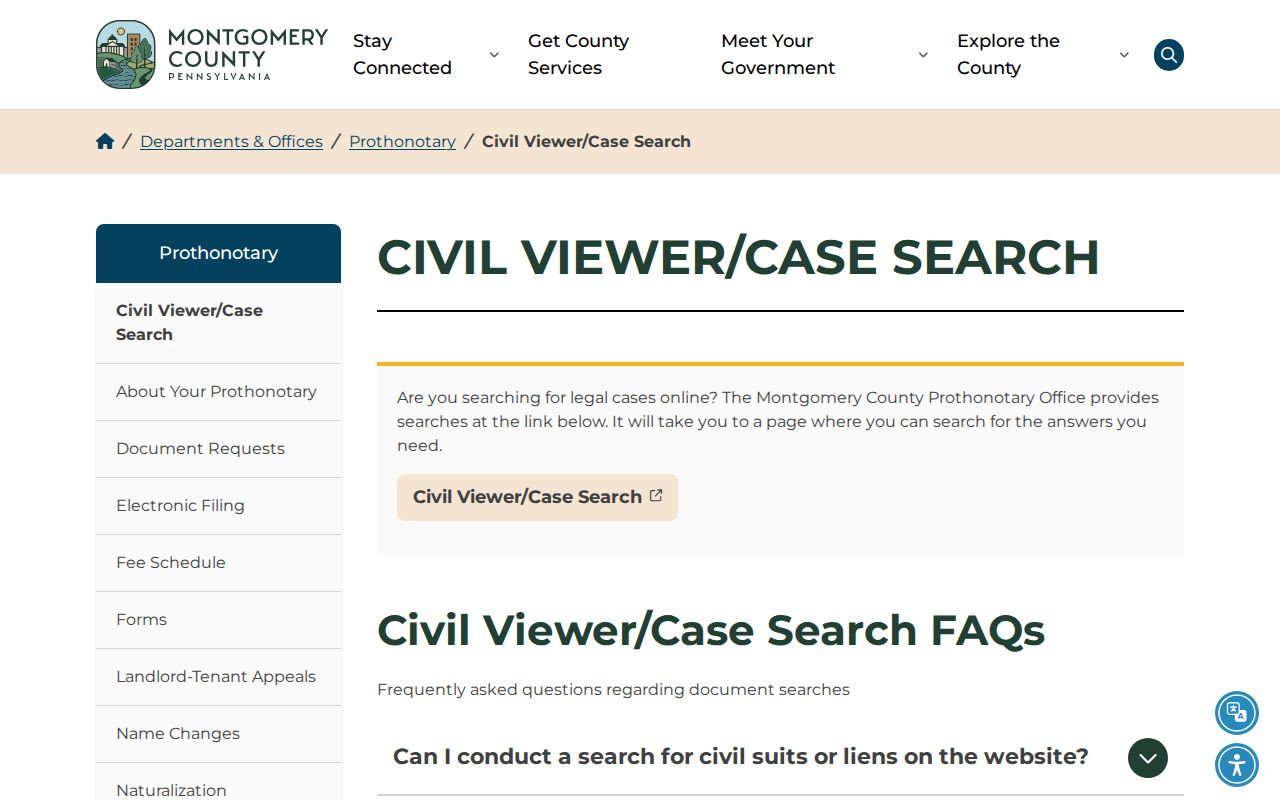
Civil records have a separate county route. The Prothonotary's Civil Viewer can search civil suits or liens on individuals or businesses and accepts card payment for docket entries and filings. Material purchased online must be viewed or downloaded within 24 hours. At the counter or by mail, copies are listed at $0.25 per page and docket printouts at $1.75. Cases started before 1960 go to County Archives for retrieval; the Prothonotary remains the route for the county's civil process and certification questions.
The Montgomery County Civil Viewer capture shows the separate civil-search channel.
For a divorce decree request, the county publishes a $5.50 charge when the case number is supplied, plus a search charge when it is not. A civil docket can identify a case trail, but it should not be used as a substitute for a certified document or a conclusion about an unrelated person with the same name.
Note: A statewide UJS docket and a county Civil Viewer result cover different court records, so compare court name and case type before treating them as one file.
Montgomery County Vital Record Routes
Date determines the correct vital-record custodian. The Register of Wills retains county births from 1893 through 1915, and County Archives reports pre-1906 material. Pennsylvania's statewide system began in 1906. The Department of Health handles modern certificate requests, while the State Archives holds mature historical birth and death certificates in the periods it lists. Under the Vital Statistics Law, a birth record becomes public after 105 years and a death record after 50 years. Restricted records are not a name-search fallback.
The official Pennsylvania birth-certificate ordering page shows the state route for an eligible applicant.
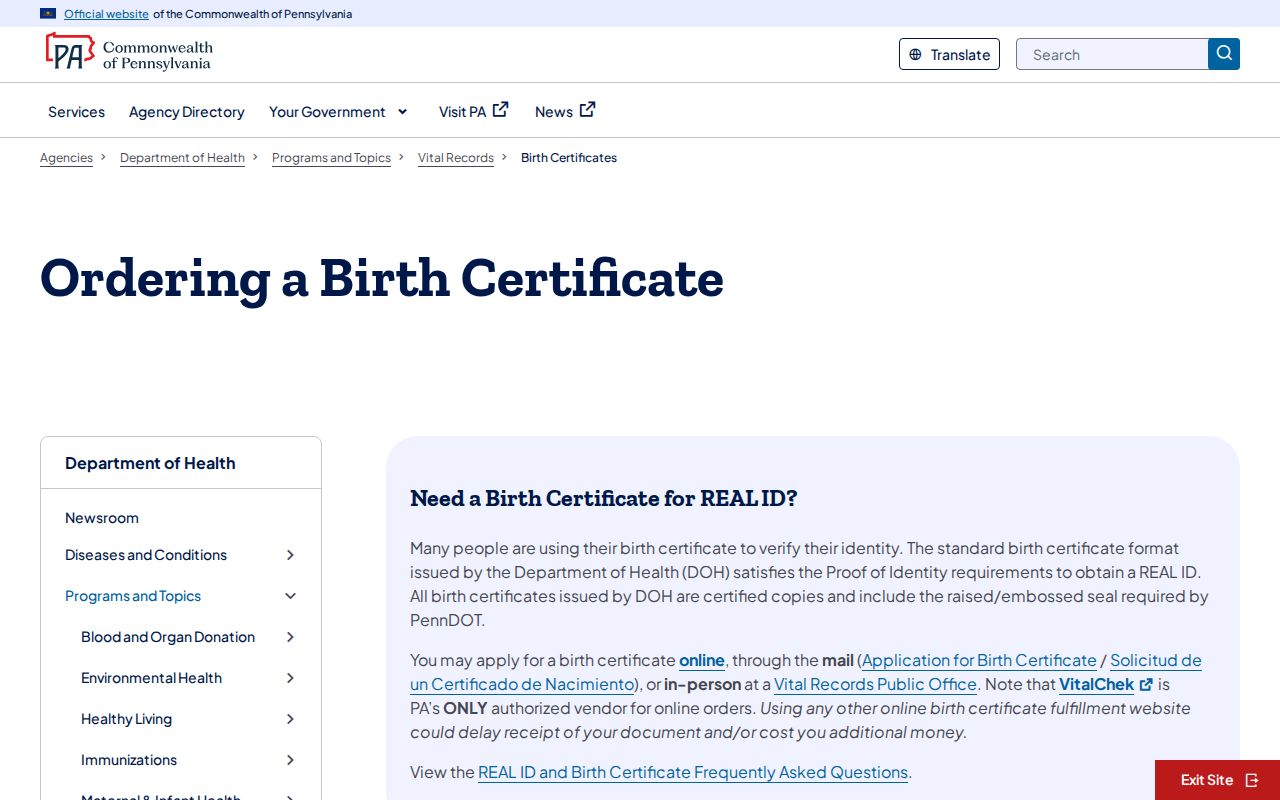
The Department of Health says a birth-certificate applicant must meet its relationship or authorization rules, provide identification, sign the application, and use its online, mail, or in-person channels. The stated certificate fee is $20, with a nonrefundable $10 online service fee. For a mature event where a non-certified copy is sufficient, the Pennsylvania State Archives offers an archival request route and lists a $5 non-certified copy fee.
Marriage licenses are held by the county that issued the license. Montgomery County states that its licenses run from 1885 to the present, with public web access after 1989 cited by County Archives. A marriage license, a divorce decree, and a birth or death certificate document different events, so none proves the others.
Montgomery County Voter Verification
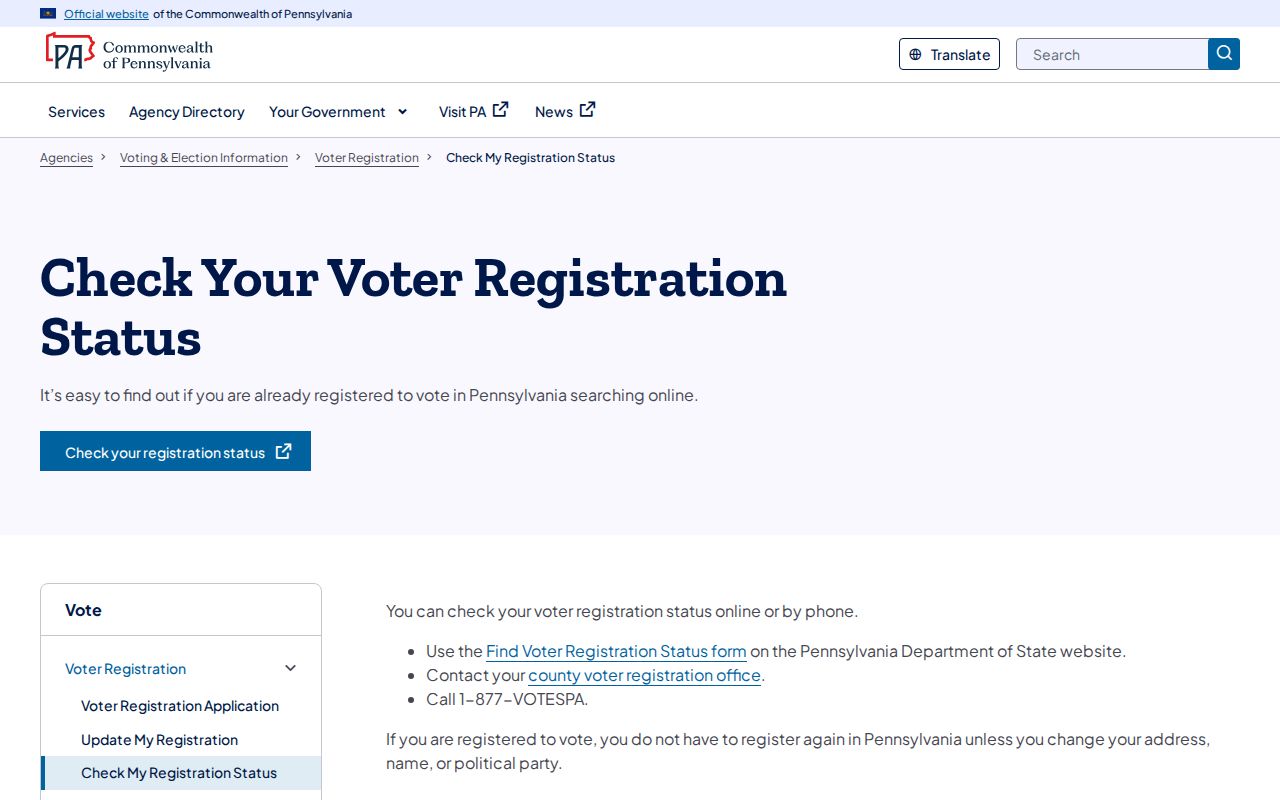
Pennsylvania separates personal status confirmation from voter-list access. The state service is for a registered elector to check registration status and polling information. It is not a public browse-by-address directory. A public-information, street, walking, or full voter list uses a separate statutory request process. The Department of State form lists defined fields and a $20 electronic-list fee. The requester must provide identification and the required written statement about permitted use.
The Pennsylvania Find Voter Registration Status route is pictured below for individual confirmation.
For a permitted list request, Montgomery County Voter Services accepts the published request channel by mail or email and says ordinary responses are generally due within ten calendar days after receipt. Its public-information and street-list rules arise under 25 Pa.C.S. §§1403-1404 and 4 Pa. Code §§183.13-183.14. The county office also maintains registration and local election functions, so it is the right contact for process questions rather than an informal request for names.
Montgomery County Lookup Myth
Myth: entering a name into the county property system will locate that person's parcel. The county expressly removed owner-name searching from Property Records on June 17, 2022. The lawful route reverses the task: start from a known address or parcel, or first obtain a documented address lead through the appropriate court, estate, recorded-document, or statutory voter-list channel. Then use the property record to confirm parcel context.
This limit improves the quality of a Montgomery County resident lookup. It forces the searcher to test a specific connection, such as a party on a recorded deed or an estate representative, rather than build a broad claim around a similar name. State business-entity and license records have similar limits: they can confirm an entity filing or credential status, not a person's current home location.
Resident Lookup Limits in Montgomery County
Pennsylvania records include deliberate privacy boundaries. The Address Confidentiality Program may substitute a mailing address for eligible survivors of domestic violence, sexual assault, stalking, human trafficking, or child abduction. Court rules limit sealed, expunged, juvenile, and confidential material. The Pennsylvania Right-to-Know Law, Act 3 of 2008, 65 P.S. §§67.101-67.3104, also exempts personal identification information at 65 P.S. §67.708(b)(6). A missing address or record may be protected by design, and the proper response is to leave that protected gap alone.
Lawful use. Montgomery County resident lookup records support personal research, family history, estate work, reconnecting, civic questions, and record verification. Using them to stalk, harass, intimidate, or harm anyone can violate Pennsylvania law.
If an official entry is wrong, contact the custodian that holds it: the Recorder for recording questions, Assessment for property data, Voter Services for registration procedure, the court clerk for case access, and Vital Records for a statutory correction process. Do not send identity documents to an unverified address.