
Montgomery County Past Resident Sources
Previous residents research in Montgomery County is a time-layer exercise. A Montgomery County Recorder document records a land transaction. A directory or telephone book provides a printed subscriber or address snapshot. A census records a household at its enumeration date, while an estate, obituary, cemetery file, or vital record may establish an event or relationship. Start with the source closest to the period in question, then use another independent source to test the address and name.
| Historical source | Years it reaches | Where held | What it can establish |
|---|---|---|---|
| Recorder land records | September 10, 1784 to the present record system; deeds and mortgages indexed as of May 8, 2026 | Recorder public system, counter, or mail | Recorded deed, title, or plan trail; remote images require paid access |
| Probate docket books | 1784 through 1987; computerized from 1988 | Register of Wills and County Archives | Estate path and estate relationships, not a complete occupancy record |
| County birth and death material | 1893 through 1915, with pre-1906 archival material | Register of Wills and County Archives | Historical event clues subject to incomplete registration limits |
| Marriage licenses | 1885 to present county issue coverage | Register, Archives, and request route | Couple and license-date clue; online access after 1989 is noted by Archives |
| Norristown directory evidence | Confirmed references for 1880, 1882, 1890, and 1951 | Historical Society of Montgomery County | Dated name and address snapshot, not a verified continuous run |
| Norristown telephone directories | 1938-1945, 1946-1949, 1950-1952, and 1962-1963 | Library of Congress online collection | Subscriber or business street-address snapshot |
| Pottstown criss-cross directory | 1950 | Library of Congress address-directory inventory | Address-to-listed-name research lead |
| Federal census | Through 1950 in 2026 | National Archives and genealogy repositories | Household at a census date, with year-specific address context |
That range is why a record missing from one portal is not proof that a Montgomery County past household did not exist. Older Montgomery County material may be at the counter, in County Archives microfilm, on a library shelf, or in a state archival route.
Montgomery County Deed Chain
A Montgomery County deed chain follows the land backward, not a person's name across every record. Begin at the current street address in the Board of Assessment Appeals Property Records application. Capture the TAXPIN, municipality, street form, and any legal-description reference. The Recorder's Public Access System publishes address, parcel-ID, and name search modes after account creation, so the parcel and address become the bridge to the recorded transfer history.
- Find the known address or parcel in Property Records and preserve the county parcel identity.
- Use that address or parcel in the Recorder system to locate the current acquisition document and note its recording date, parties, and legal-description references.
- Search the seller from that document as a grantee to find that seller's earlier acquisition. The seller in one transfer can be the earlier buyer.
- Repeat one conveyance at a time, comparing the legal description, plan reference, and parcel identifiers at each turn.
- When the web image is unavailable, choose the Recorder counter computer, mail-copy route, subscription, or e-certified copy process. Use County Archives or historical channels for the older series they hold.
- Grantor and grantee
- The grantor transfers an interest in land; the grantee receives it. Those roles make the backward deed step possible.
- Chain of title
- The sequence of recorded transfers for the same land. It is an ownership trail, not a full list of every past household.
- Legal description
- The lot, plan, block, subdivision, or other land description carried in a deed. It can remain useful when a street label changes.
- Criss-cross directory
- An address-organized directory that can supply a dated listed-name lead, then needs confirmation from another record.
The Recorder's historical research resources point property-history researchers to County Archives, HSMC, historic atlases, and state and federal archival institutions.
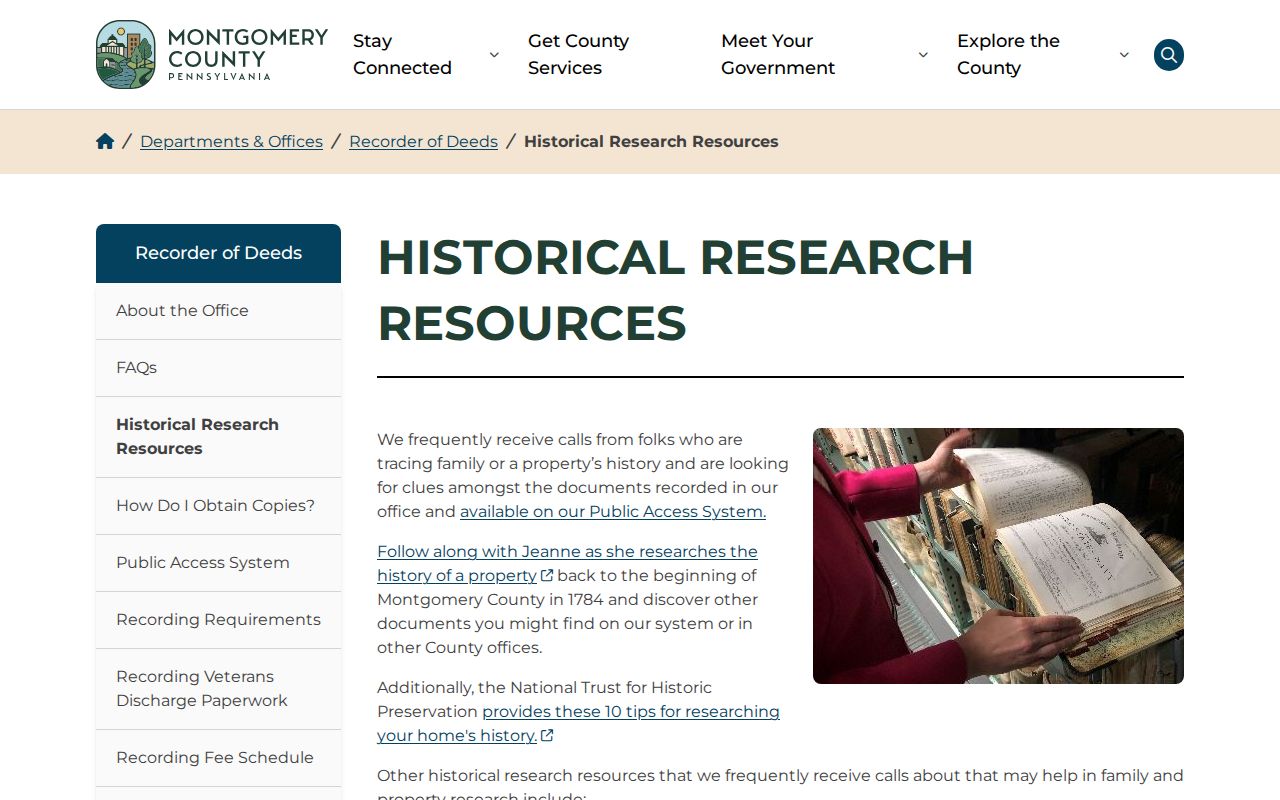
The county's house-history referrals reinforce the need to use the land trail alongside archival and directory evidence.
Montgomery County Previous Resident Gaps
Montgomery County's Recorder dates its records to September 10, 1784, but the office also publishes a specific list of book gaps. Deed books 1325, 1326, 1377 through 1381, and 1540 through 1544 are listed as absent. Mortgage books 1572 through 1580, 3340, and 3454 are also absent, as are plan books 16 through 21. This is more helpful than a vague warning that old records may be incomplete.
Insider tip. Plan book numbers use three digits and replace a hyphen with zero. An A-4 reference becomes A004. Landside books start with L, condominium plans with T, highway plans with H, and plan-case books use a PC01-style format. If the title trail lands on a known gap, search adjacent deeds, grantor and grantee indexes, a legal description, estate material, and the Recorder counter before treating the transfer as missing.
Montgomery County Previous Resident Access
The Montgomery County Recorder's online index is only one access channel. A free account lets a user reach Search Public Records, but remote images require a $25 calendar-day subscription or a $300 monthly subscription. Plain copies under a subscription are $0.50 per page. The county also provides public computers at the Recorder counter, mail copies, and immediate e-certified copies for $10.50 after payment. A written mail request should include the owner name, address plus municipality, parcel ID, book and page if known, and contact information.
Montgomery County older history has its own handoffs. County Archives holds historic departmental microfilm and pre-1906 vital material, and it cannot certify a record. The Register of Wills retains probate docket books for 1784 through 1987, then computerized records from 1988 onward. The correct custodian matters more than a generic records request: a Recorder copy follows the Recorder's fee process, while an archival retrieval may identify the appropriate office for a certified record.
Montgomery County Archival Record Retrieval describes the county's older-record access channels.
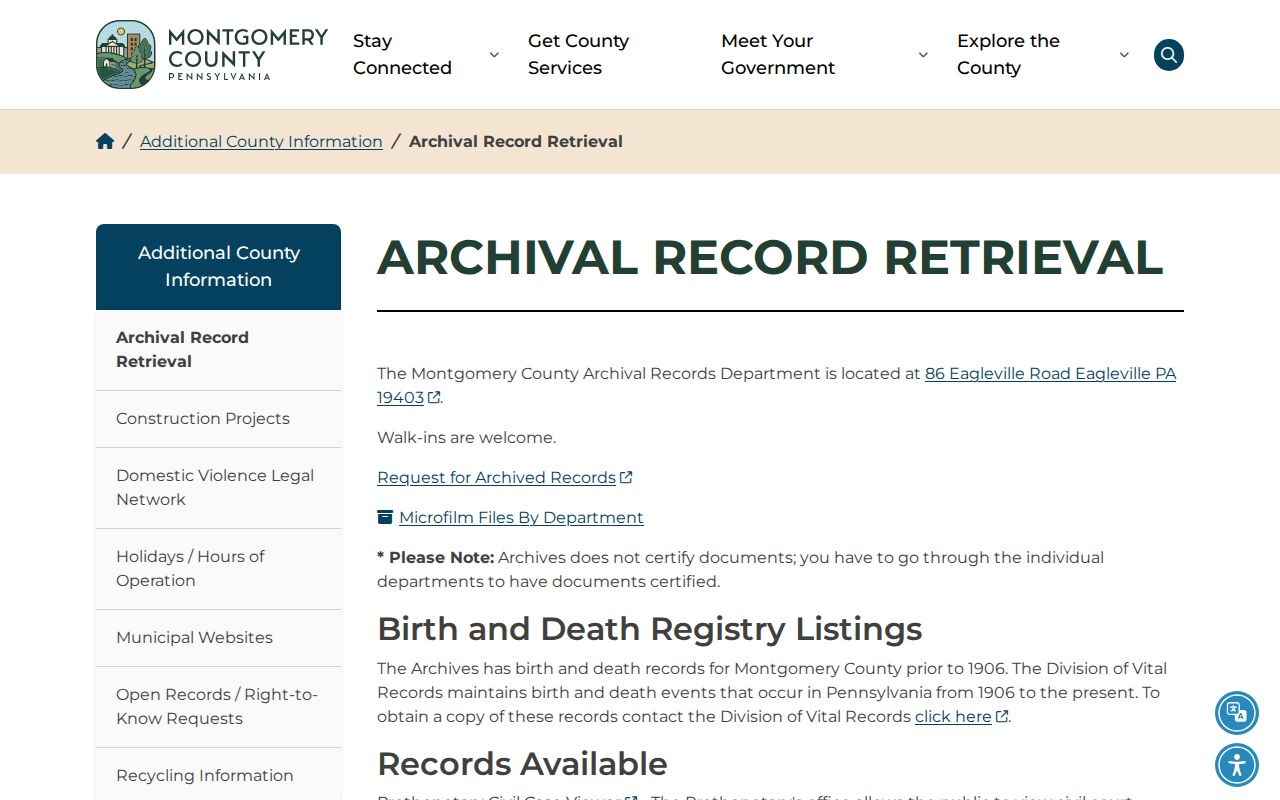
Archives retrieval is the fallback when a historical county record is not available through the current online system.
Note: The Pennsylvania Right-to-Know Law does not replace the specialized copy process for Recorder, court, or vital records.
Montgomery County Past Address Continuity
A Montgomery County past address may be printed under a postal community, a borough, a township, or a different street form from the modern tax map. Montgomery County's records cross 62 municipalities and several postal geographies. Norristown, Pottstown, Lansdale, a Main Line postal name, and a township can all appear in a historical trail. Preserve every version instead of treating the modern mailing form as the only valid name for the location.
Use the exact street spelling, municipality, ZIP or postal name, parcel number, lot or plan reference, and legal description together. The research did not find an authoritative countywide street-renumbering year, so there is no basis for a one-size-fits-all renumbering rule. When a directory address does not match the current parcel display, test the historical form and the land description before assuming a move.
Montgomery County Past Households
Montgomery County past residents become clearer when an address directory and census schedule are paired rather than substituted for one another. HSMC documents Norristown city-directory evidence for 1880, 1882, 1890, and 1951. The Library of Congress identifies digitized Norristown telephone-directory reels for 1938 through 1945, 1946 through 1949, 1950 through 1952, and 1962 through 1963. Its criss-cross guide also identifies a Pottstown address directory for 1950. Each is a dated listing, not proof of every person at the address.
- Pick the directory or telephone volume closest to the target year and transcribe the name, initials, business name, address, and street form as printed.
- Compare the volume immediately before or after it. Record a spelling change, missing listing, or street-number change without assuming the reason.
- Pair the directory trail with the relevant decennial census. The 1950 census is the most recent federal population census available in 2026.
- Test the same address or person in the deed chain, probate path, obituary, or historical map. Each source answers a separate time-specific question.
The Historical Society of Montgomery County offers on-site research and a $30-per-hour remote research service when an identified local directory or place file is not online. The detailed holdings and reading limits belong with the Montgomery County city directories collections. For an address trail, use those volumes as a checkpoint between transfers rather than a substitute for a land record.
Montgomery County Estate Trail
The Montgomery County Register of Wills and Clerk of Orphans' Court offers a distinct past-residents path through estates, probate, marriage licenses, and historic county birth records. It is located at 425 Swede Street in Norristown, and its genealogy guidance says probate docket books cover 1784 through 1987 before the computerized era. An estate can name a decedent, representative, heirs, or an action connected to land, but it does not establish a full address roster.
The Register also says it retains birth records for people born in Montgomery County from 1893 through 1915. Montgomery County marriage licenses run from 1885 to the present under the county request form. Those dates direct a researcher to the right time layer rather than suggesting that the Recorder holds vital records. Online public access, e-filing, counter, form, and archival channels each have a separate role.
The Register of Wills page identifies the county probate, marriage, and historical birth-record routes.
An estate filing can provide a family-history lead that should be compared with the address and recorded-land timeline.
Montgomery County Past Vital Clues
For an older Montgomery County past-residents question, vital material has a date-based route. Pennsylvania's Vital Statistics Law makes a birth record public after 105 years and a death record public after 50 years. The Pennsylvania State Archives request page lists original birth certificates for 1906 through 1920 and death certificates for 1906 through 1975, with a $5 non-certified copy. Its coverage changes as transfers occur, so the current source page should be checked before an order.
County and state holdings overlap without becoming identical. The County Archives has pre-1906 material, the Register holds county birth records for 1893 through 1915, and the Department of Health issues birth and death certificates from 1906 forward under its eligibility rules. A missing event in one source does not resolve the address trail. Church, cemetery, newspaper, probate, and family sources may provide a separate clue.
Pennsylvania State Archives historical vital requests explains the archival request route.
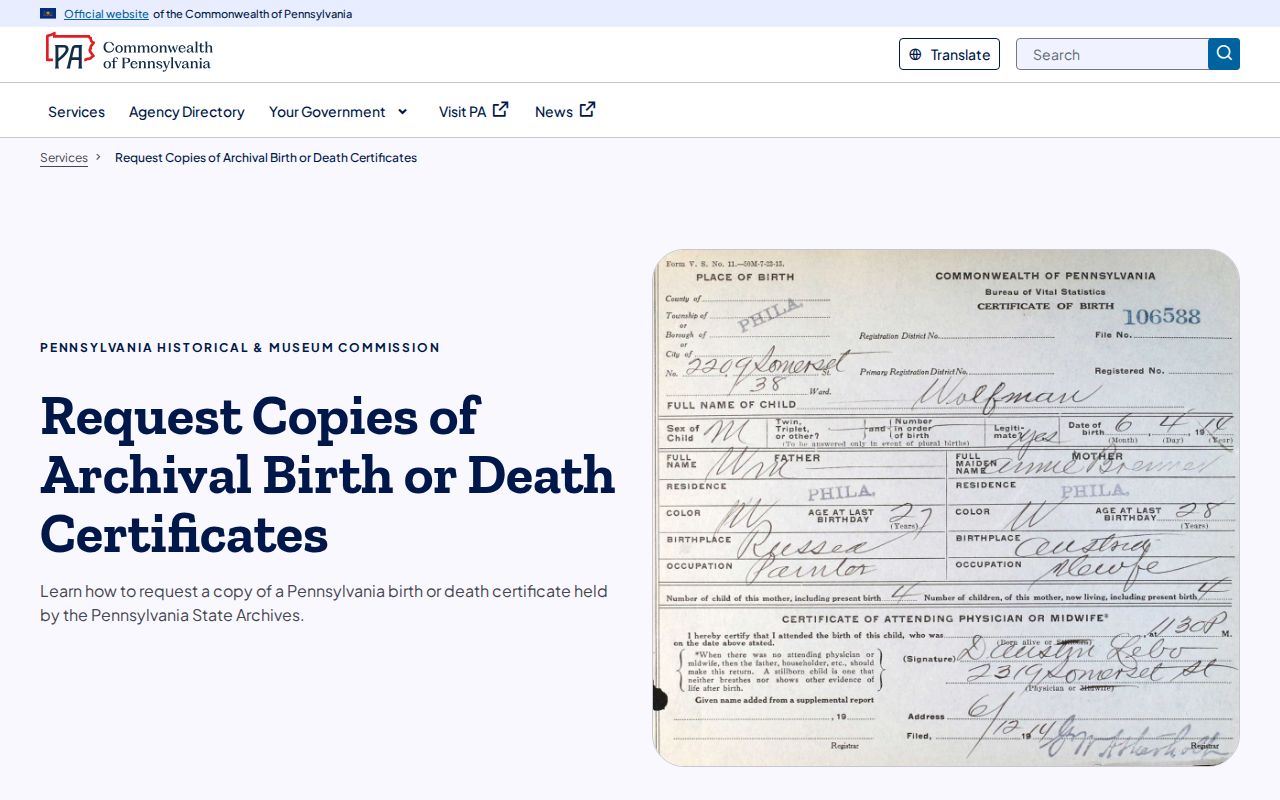
A historical certificate request can document an event, but it should be connected back to an address only through corroborating records.
Montgomery County Previous Resident Limits
Montgomery County past residents research is well suited to house history, family history, estate questions, reconnecting with an old classmate through appropriate archival sources, and verifying a record with its custodian. It does not authorize pursuit of people who are not named in a public record, nor does a deed establish every person who lived at the address. An address-associated mailing field, cemetery finding, or telephone listing should be read only for the limited fact it supplies.
When a record is restricted, sealed, absent, or unclear, preserve the gap and ask the responsible custodian about access procedure. The proper response to an incomplete historical trail is another documented source, not an invented connection.